Guide
Short-term rental financing: the STR DSCR guide
How short-term rentals get financed on the property's income, what to check before you write the offer, and where qualifying for the loan ends and real cash flow begins.

Check the deal before the offer. Thinking about a short-term rental? This guide helps agents and investors spot the financing questions to resolve before an offer goes in.
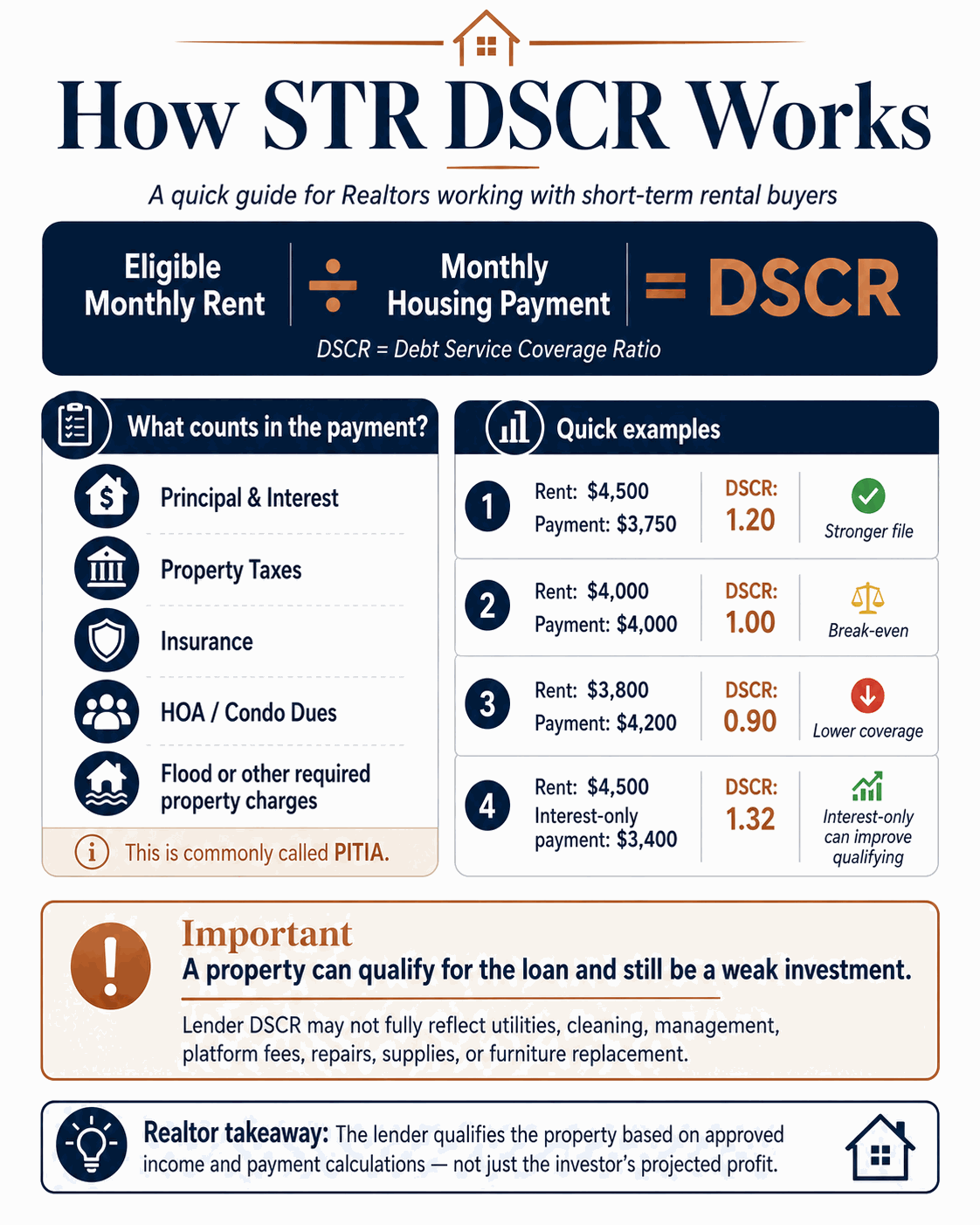
Gross bookings are not profit. Seasonality, local rules, operating costs, insurance, management and vacancy all affect the investment. Use this as a financing starting point, not a profitability forecast. Eligible rental income and program rules vary by lender and property.
Before you write: send me the property address, intended rental use, estimated purchase price and expected rent. I'll help you identify the financing questions to work through early.
What is an STR DSCR loan?
An STR DSCR loan is typically business-purpose financing for a non-owner-occupied property. The lender weighs the property's eligible income against a qualifying property payment. Personal guarantors are commonly reviewed for credit, assets, reserves and other program requirements. Guidelines vary by lender.
How lenders evaluate STR income
Income methods differ by program and property history. A lender may use market-rent analysis, short-term rental data or projections, leases, or documented operating history. Not every lender accepts the same method, or the full gross booking estimate. Confirm the income method and the required documents before the offer.
Qualifying for the loan is not the same as cash flow
DSCR is an underwriting ratio. A 1.00 ratio generally means the lender-recognized rental income equals the lender's qualifying property expense. It is not a full cash-flow analysis. Your investor model should also account for management, cleaning, utilities, maintenance, furnishing, vacancy, taxes, insurance, platform fees and seasonal swings.
Pre-offer checklist
Five things to nail down before an STR offer goes in.
- Confirm local, HOA and condo rules allow the intended STR use.
- Ask the lender how rental income will be calculated and documented.
- Confirm STR insurance, down payment, reserve and property requirements.
- Model operating costs, seasonality, vacancy and management.
- Confirm the ownership or LLC structure, hold period and any prepayment terms with the right professionals.
When it may fit
DSCR financing may be useful for investors with variable income, substantial tax deductions, or multiple financed properties. Eligibility and pricing still depend on the borrower, the property, leverage, the income calculation and the lender. The occupancy and use must match the loan documents. This is not a second-home loan.
How lenders actually calculate STR income
Here is the part that trips people up: there is no single industry standard for short-term rental underwriting. The method varies from lender to lender, so the real skill is knowing which one a given lender uses and lining up the right documents for it. Three approaches are common.
Method 1: Existing STR history
If the property already runs as a short-term rental, a lender can qualify it on its trailing 12 months of actual income, often called the T12. They rebuild that history from primary documents: bank statements showing deposits, property-management statements and monthly booking reports, Airbnb and Vrbo statements, and proof that the listing belongs to the subject property. The income is counted net of management and vendor fees, not off gross bookings.
Method 2: Projected STR analysis
With no operating history, a lender may build a projection from an approved automated STR report (for example AirDNA), an STR appraisal narrative, a property-management projection, or market average daily rates and occupancy. The lender then applies its own weights and filters. The catch that surprises people: a lender accepting an automated report does not mean it will use the full gross number on it. Lenders discount projections.
Method 3: Long-term market rent
Some programs fall back to standard long-term market rent using Form 1007, the appraiser's rent estimate for a one-unit investment property. On its own, Form 1007 should never be treated as proof of nightly or weekly STR income. Certain DSCR programs require both the Form 1007 analysis and an approved STR report to manage risk.
| Method 1: Existing history | Method 2: Projected analysis | Method 3: Long-term rent | |
|---|---|---|---|
| Time horizon | Retrospective, trailing 12 months | Predictive, future estimates | Traditional, conservative fallback |
| Primary evidence | Bank statements, Airbnb and Vrbo ledgers | Automated STR report, STR appraisal, PM projections | Form 1007 |
| The critical caveat | Counted net of vendor and management fees | Lenders apply their own weighting to the data | Not a one-to-one replacement for nightly STR income proof |
The advisor's script
Set the right expectation before a buyer falls in love with a projection.
Don't say
"The report says it makes $80,000, so the lender will use $80,000."
Say this instead
"The lender will review the property, the projected or historical STR revenue, and its own approved income method before confirming the qualifying rent."
The move is simple: shift the burden of proof from the software to the specific lender's underwriting guidelines. That one habit keeps a buyer from anchoring on a number no lender promised.
STR DSCR financing FAQs
How do lenders evaluate STR rental income?
Does the borrower need tax returns or pay stubs?
What down payment and credit score are needed?
Can a first-time investor qualify?
How much should the investor keep in reserves?
Are interest-only options and prepayment penalties common?
Does a DSCR below 1.00 automatically disqualify the property?
LLC ownership and vesting FAQs
Can an STR DSCR property be purchased in an LLC?
When should the LLC be set up?
What documents may be requested?
Can the buyer switch to an LLC after signing?
Can the property be transferred into an LLC after closing?
Does the LLC need a bank account or special insurance?
This guide is a financing starting point, not a profitability forecast or legal, tax or insurance advice. Eligible rental income, program rules and entity requirements vary by lender, property and professional guidance.
Bring me the property before you write
Send me the property address, intended rental use, estimated purchase price and expected rent. I'll help you identify the financing questions to resolve before the offer.